XGRIDS Restocked in Australia: Why a Full Warehouse Means Nothing
The XGRIDS shipments have landed and AECT is fully stocked in Australia again after selling out for EOFY. But stock is only half the promise — here is what happens after the box leaves the shelf.

Over the past week the XGRIDS shipments have been landing. After selling out our last round of stock for EOFY, AECT Solutions is fully stocked again in Australia and ready to meet demand from both clients and partners.
That is the easy half of the announcement. The harder and more honest half is this: stock on a shelf is only half the promise.
Selling out before EOFY was a good problem to have
End of financial year is when Australian businesses actually commit capital. Scanners that had been sitting in someone's "next year" column turned into purchase orders, and our last round of XGRIDS inventory cleared out completely. That is a good problem. It is still a problem, because a distributor with no stock cannot say yes to the project that starts on Monday.
So we restocked properly rather than topping up a single popular SKU. The lightweight scanners, the survey-grade units, and the 3D Gaussian Splatting hardware are all back in Australia, in our hands, and available for immediate allocation to clients and to our reseller partners.
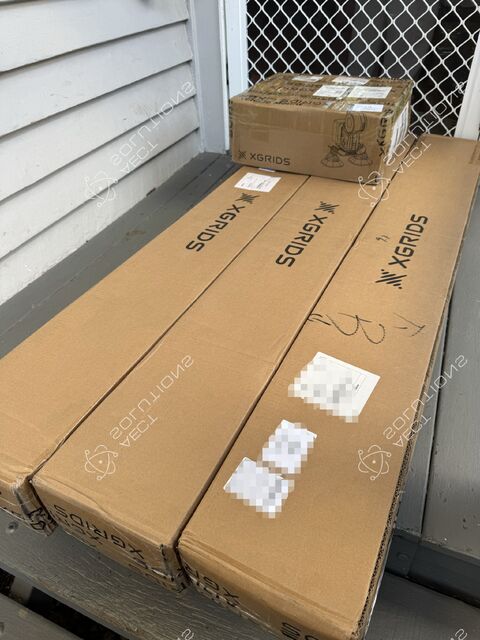
XGRIDS shipments landing in AECT's Australian warehouse, July 2026.
Stock is only half the promise
A full warehouse means nothing if the gear sits idle on someone's desk.
Everyone in reality capture has seen this happen. A team buys capable hardware with genuine intent, the box arrives, and three months later it is still in the corner of the office with the plastic on. Not because the technology failed, but because nobody was there on day one to turn a device into a repeatable workflow.
So the week ahead looks like every good week does. I am out on the road again, onboarding and training clients across the country. We deliver in person, put the gear in your hands, and make sure you are producing from day one. That is what turns hardware into real ROI instead of a science project that quietly gets written off at the next asset review.
What an in-person handover actually covers
- →Your first scan on your own site, with your own conditions — not a showroom loop
- →The full processing path walked end to end, from capture through to a deliverable you can hand a client
- →The failure modes: where SLAM drifts, when to close a loop, what movement and lighting do to a dataset
- →Output formats matched to whatever your downstream team actually opens — las, e57, RCP, obj
- →A named person to call afterwards instead of a ticket queue in another timezone
Every XGRIDS purchase from AECT includes complimentary remote onboarding, plus the option of an in-person session anywhere in Australia for teams who want the hands-on version. Structured training sits above that for organisations rolling capture out across multiple crews rather than a single operator.
Real confidence, not manufactured
I am a bootstrap founder who has personally run more than 1,000 scans across the full XGRIDS product line. That number is not a marketing flourish. It is the reason I can tell you which unit suits your job, and just as importantly when a cheaper or simpler option will do, built on 15 years of hands-on experience across multi-national, multi-vertical industries.
The other half of that background is compliance. As an ISO, HSEQ and IMS specialist, my instinct on any dataset is whether it will hold up when someone challenges it — in an audit, in a variation claim, or in a dispute two years after handover. End-to-end and outcome-first is not a slogan here; it is the only way I know how to assess whether a capture workflow is genuinely worth buying.
What is back on the shelf in Australia
- →Lixel K2 — lightweight SLAM scanner under 1 kg with built-in RTK, real-time colourised point cloud and 3 cm absolute RMSE accuracy
- →Lixel L2 Pro — 32-line handheld and drone-mountable SLAM LiDAR, plus or minus 1 cm relative accuracy
- →PortalCam — 870 g four-camera array purpose-built for 3D Gaussian Splatting capture
- →LixelStudio and LCC — LixelStudio ships free with three permanent PC keys on every XGRIDS SLAM LiDAR scanner, and LCC Basic covers unlimited local single-scene 3DGS reconstruction
If you are not ready to commit capital, the same units are available to rent with training included, so you can prove the workflow on a live job before it becomes a line item on your balance sheet.
Frequently Asked Questions
How long does it take to get an XGRIDS scanner once I order?
Standard lead time on XGRIDS scanners and accessories is two weeks from receipt of full payment. When units are already in stock in Australia, as they are right now, that timeline compresses considerably. For local clients we generally hand-deliver the unit as part of an onboarding visit rather than shipping a box and hoping it gets opened, so the delivery date and your first productive scan tend to be the same day.
Fully stocked. On the road. Ready to go again. If you have been waiting on availability, or you want to talk through which unit actually fits the work in front of you rather than the one with the best spec sheet, get in touch and we will find a time. I would rather bring the gear to you and put it in your hands than send you another brochure.
Related Articles
Talk to Our Team
Every article is backed by real project experience. Book a discovery call and let's discuss your specific project.