EOFY Scanner Delivery: Why Stock and Onboarding Beat Lead Times
Up at 4:30am for the first flight from Brisbane to Sydney, then two weeks of in-person client onboarding across Sydney and Melbourne before June 30. Here is why stock already sitting in Australia — and a founder on site — matter more than a delivery promise.

Up at 4:30am. First flight out of Brisbane to Sydney. For the next two weeks I am on the ground in Sydney and Melbourne, personally demonstrating and onboarding AECT clients ahead of the end of the financial year.
This is not a travel post. It is the part of the job that decides whether a scanner purchased in June is actually producing deliverables in July.
EOFY is the busiest window in our industry
Every year in the run-up to June 30, the same pattern plays out across Australian survey, construction and engineering teams. Budgets have to be committed. Kit has to be purchased, delivered and operational before the cutoff. And every year, the same thing happens: supply runs dry, lead times blow out, and great teams miss the deadline through no fault of their own.
The failure is rarely the buyer's. It starts as a supply problem and ends as a capability problem. A team that misses the cutoff does not just miss a tax outcome — it misses a full quarter of capture work it had already planned around.
Stock secured from end of April, not promised for July
Our EOFY stock of the XGRIDS Lixel K2 was secured and ready from the end of April, sitting in our Australian warehouse. No back-ordered. No maybe by July. When we commit to a delivery date, we hit it.
The units we hold for this window are the three XGRIDS platforms Australian teams are buying most right now:
- →XGRIDS Lixel K2 — a sub-1kg SLAM scanner with built-in RTK, 1cm relative accuracy and 3cm absolute accuracy (RMSE), and a real-time colourised point cloud on screen while you walk.
- →XGRIDS Lixel L2 Pro — 32-line handheld and drone-mountable SLAM LiDAR at ±1cm relative and ±3cm absolute accuracy with RTK, built for corridor and aerial LiDAR work.
- →XGRIDS PortalCam — an 870g four-camera array purpose-built for 3D Gaussian Splatting capture.
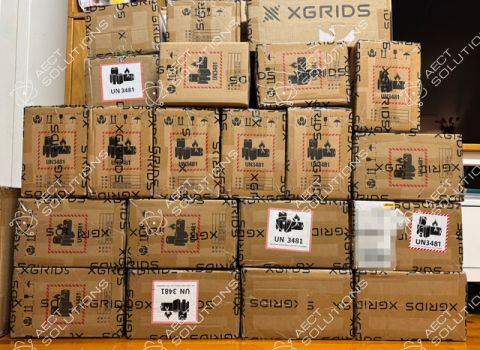
EOFY stock, secured and ready in AECT's Australian warehouse from the end of April.
Hardware on a shelf isn't the goal. Getting your team capturing, processing and delivering with it — that is.
Why I fly instead of ship
A scanner that arrives right on the cutoff and stays in its case for weeks afterwards has not delivered a return. It has delivered a depreciating asset. The gap between purchase and productive use is where most equipment investments quietly lose their business case, and no spec sheet closes that gap for you.
So for two weeks I am doing the unglamorous part in person: walking sites with clients, running first captures with their own crews on their own assets, and staying until the data comes out the other end.
What an onboarding session actually covers
- →First capture on the client's own site, not in a demo room
- →Processing that scan through LixelStudio, which ships with three permanent PC licences at no extra cost with every XGRIDS SLAM LiDAR scanner
- →Choosing the output the downstream workflow actually needs — las, e57, RCP or mesh
- →Putting the device in the hands of the person who will use it weekly, not only the person who signed the purchase order
- →Agreeing what a good result looks like on their first paid job with it
Every purchase includes complimentary remote onboarding, plus the option of an in-person session anywhere in Australia. Both do the same job: move a team from owning a device to running a workflow.
If you are buying before June 30
A short checklist, from someone who has watched this window go wrong for good teams:
- →Confirm the unit is physically in Australia, not in transit or sitting on allocation.
- →Ask for the lead time in writing. Ours is two weeks from receipt of full payment on XGRIDS scanners and accessories.
- →Book the onboarding session when you place the order, not after delivery.
- →Nominate the operator now and protect a day in their calendar for the first capture.
- →Check the processing PC before the device lands, so nothing stalls at the software step.
Frequently Asked Questions
Why does AECT onboard clients in person instead of just shipping the hardware?
Because the real risk in a geospatial hardware purchase is not the box arriving late — it is the team never reaching a confident first deliverable. In-person onboarding compresses that learning curve into a single working day: the operator runs a real capture on a real site, processes it, and exports something usable while there is still someone standing next to them to answer questions. That is what going from risk to ROI looks like in practice, and it is why the founder is on the tarmac to back it up.
Sydney and Melbourne, I will see you over the next two weeks. If your team is weighing up a scanner before June 30 — or you already have one sitting in its case and want help getting it into production — get in touch and we will work out what your first capture should be. And if you would rather build the skills before the hardware arrives, our training programs cover exactly the same ground.
Related Articles
Talk to Our Team
Every article is backed by real project experience. Book a discovery call and let's discuss your specific project.