XGRIDS Lixel L3 launched at INTERGEO 2026: 5 mm accuracy, built-in RTK, 4K HDR — and it's coming to every state
XGRIDS' new flagship handheld SLAM scanner is out. What the Lixel L3 actually is, the numbers that matter, how it sits against the L2 Pro and K2, and how Australian teams get one — pre-orders, the 19 September demo unit and Jacob's national roadshow.

Today at INTERGEO in Munich, XGRIDS launched the Lixel L3, the new flagship of its handheld SLAM range. AECT Solutions is the XGRIDS National Distributor for Australia, so we are taking Australian pre-orders from launch day, our demo unit lands on 19 September, and I am taking it on the road to every state and territory. This is the plain-English version of what it is, who it is for, and how to get one.
What the Lixel L3 is
The L3 combines a 0.7–120 m LiDAR (16- or 32-channel), a three-camera 4K HDR vision system (three 1/1.3-inch sensors), a built-in survey-grade RTK receiver, a 4.3-inch on-device display and real-time processing inside the unit. One walk of a site produces a true-colour point cloud, a photorealistic 3D Gaussian Splatting scene and a mesh — the same family of outputs our customers already use from the Lixel K2 and Lixel L2 Pro, at a new level of accuracy.
The numbers that matter
- →Relative accuracy 5 mm (1σ, XGRIDS 500 m² test environment) — validated across 7 units, 20 scans and 1,524 distances against a total station: 4.2 mm at P68 with no control points
- →Absolute accuracy 2 cm horizontal and vertical (RMSE, post-processed); 2.5 cm in real time on the device
- →Point cloud thickness 5 mm or better; levelling 0.005° with RTK fusion
- →Cameras: three modules, each on a 1/1.3-inch sensor (3 × 1/1.3") — two 200° × 200° panoramic plus one forward — 4096 × 3072, DCG HDR
- →About 2.5 kg including battery, IP54, roughly 100 minutes per quick-swap battery, 1 TB storage
- →Outputs: .las, .rcp, .e57 and .ply point clouds, .osgb/.obj mesh, .lcc/.lcc2 3DGS, 3D Tiles, and Creator Data for your own pipelines
Three things the L2 Pro could not do
Local upsampling. XGRIDS' own technique lets you raise point density to 1–5 mm on the areas that matter — a column base, a flange, a heritage detail — without carrying that density through the whole scan.
Control-point-free map fusion. Separate scan segments are matched by region selection and ICP, and the fusion can run in the cloud or fully on a local machine. The fully local option is the one that matters for government, infrastructure owners and anyone with a data-sovereignty clause — the same reason we process onshore in Queensland.
RTK, screen and processing in the unit. Control points are collected from the screen on a standard survey pole, coordinates convert to WGS84 in real time, and loop closure, moving-object removal and a low-feature mode for tunnels and plant rooms all run on the device before you leave site.
L3 vs L2 Pro vs K2 — which one for which job
This is a dual-track range, not a replacement. The L2 Pro stays the long-range choice: the 300 m configuration, vehicle mounting and drone mounting on the Matrice 300/350 for air-ground fusion. The K2 stays the everyday sub-1 kg unit for fast site records and 3DGS. The L3 is the precision handheld for surveyors, Scan-to-BIM teams and infrastructure and facility owners who need 5 mm relative and 2 cm absolute in one pass, with the control workflow built in.
- →Lixel L3 — 5 mm relative / 2 cm absolute · 0.7–120 m · built-in RTK · 4K HDR · on-device display · about 2.5 kg
- →Lixel L2 Pro — 1 cm relative / 3 cm absolute · up to 300 m · external RTK · vehicle and M300/M350 mounting · about 3 kg with RTK module and phone
- →Lixel K2 — 1.2 cm relative · built-in RTK · three cameras · under 1 kg
The full side-by-side table is on the Lixel L3 page.
Who should look at it first
Surveying and mapping. Construction and Scan-to-BIM. Tunnels and infrastructure. Facility and asset management. Mining and forestry. Film, VFX and heritage. If you deliver against a client accuracy specification — Transport for NSW's Digital Engineering Framework is the one we are asked about most — the L3's 5 mm relative figure is a step change for handheld SLAM. Absolute accuracy still comes from your control network, and we validate both with you on delivery.
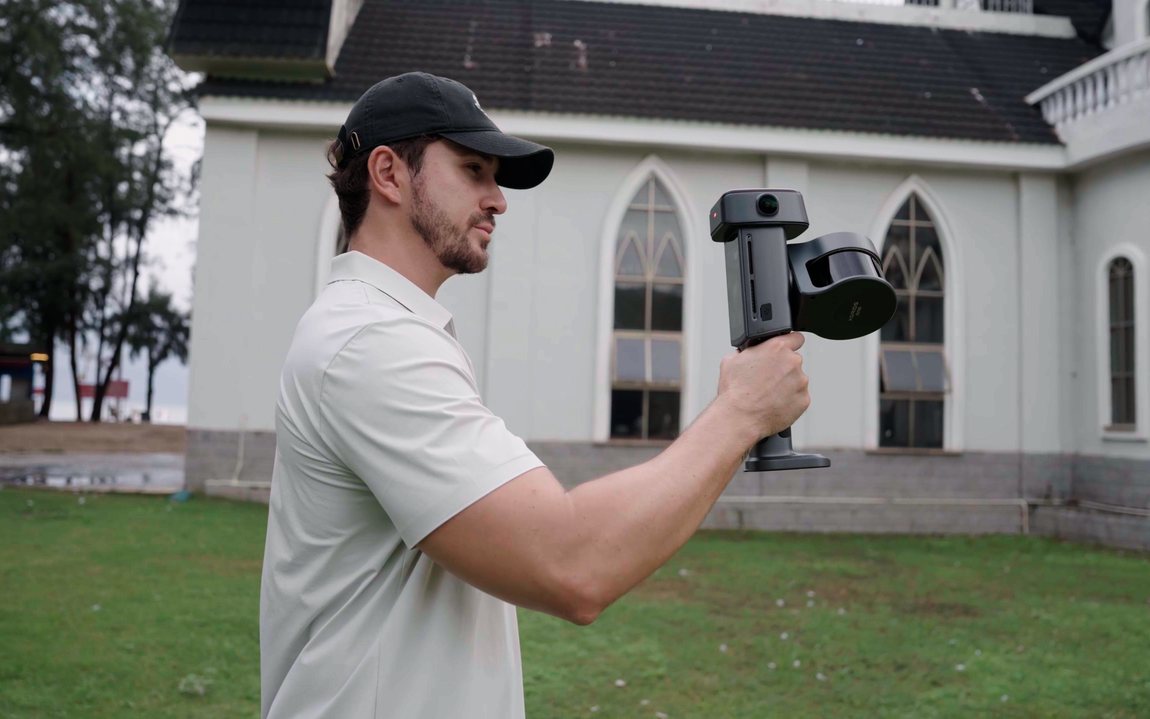
Lixel L3 with the optional support rig — the rig carries the weight, the operator steadies it.
Australia: pre-orders, delivery, demos and the roadshow
Pre-orders are open through AECT from today. Pricing is not published online — we quote your configuration after a short consultation, because the right answer depends on the channel count, the software you already hold and whether you are moving up from an L2 Pro or K2. A $2,000 deposit reserves a first-shipment unit, with October 2026 delivery, four to five weeks from the global launch date. Every unit ships with three permanent LixelStudio licences and LCC Basic, plus AECT onboarding and training.
Our demo unit — one of nine first-batch L3s worldwide and the only one in Southeast Asia and Oceania — arrives on 19 September. From there I am taking it on the road: Brisbane, Sydney, Melbourne, Adelaide, Perth, Hobart, Canberra and Darwin — and regional centres where there is demand. Live scans, the L2 Pro and K2 side by side, hands-on time and pre-orders on the day. Dates go to registered contacts first.
The spec sheet tells you what the L3 can do. The roadshow is where you find out what it does on your site.
Frequently asked questions
When can I get a Lixel L3 in Australia?
Pre-orders are open now. A $2,000 deposit holds a first-shipment unit, and delivery is in October 2026, four to five weeks from the global launch date of 15 September 2026.
How much does the L3 cost?
Pricing is provided on enquiry after a short consultation — register on the L3 page and we come back to you with pricing for your configuration.
Does the L3 replace the L2 Pro?
No. The L2 Pro remains the long-range and vehicle/drone-mounted option; the L3 is the precision handheld. Both stay in the range.
Where is my data processed?
On your workstation, or through AECT's onshore processing in Queensland. The L3's map fusion can also run fully locally for sites with data-sovereignty requirements.
Get the spec sheet and register for your state on the Lixel L3 page, or book a private demo.
Related Articles
Talk to Our Team
Every article is backed by real project experience. Book a discovery call and let's discuss your specific project.